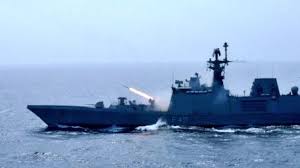
The Indian Navy today stands bold and strong. Its regarded as one of the best in the world not just in terms of numbers but more significantly due to its professionalism and skills. The Navy proved its worth in the 1971 Indo-Pak War when it initiated Operation Trident to incapacitate the Pakistanis at sea. Let’s recall that incredible operation.
Just before the 1971 war, India had acquired the Osa-I missile boats from the Soviet Union. The boats were equipped with the ship-to-ship Styx missiles and Range-out homing radars. The stealth missile boats were surely a huge boost to the Indian Navy but they had one major disadvantage – short range.
As the Pakistan Air Force took to pre-emptive strikes on our airfields on 3 December 1971 and the Indian Air Force responded by bombing their airfields, the Indian Navy got ready to join the war with their newly acquire Osa-I missile boats.
On the night of December 3, a group of these boats — INS Nipat, INS Nirghat and INS Veer – set sail from the Mumbai harbour. The next day two Petya class Frigates — the INS Katchall and INS Kiltan – joined the missile boats to form the ‘Trident team’.
The Osa-I boats were towed to the Karachi harbour by night which was the primary harbour of the Pakistan Navy and thus also its Achilles heel as Pakistan’s navy fleet and oil supplies depended on the safe existence on the harbour. The ‘wasps’, as the Osa-I boats were known, proceeded in an arrowhead formation changing course frequently with radar inputs from INS Kiltan to avoid enemy detection. The most interesting aspect was that the ship crews had been taught Russian so that their talks wouldn’t be understood by the Pakistanis!
At 10:43 pm the Rangout radar on INS Nirghat picked up a big target — PNS Khyber – a destroyer of the Pakistan Navy. This was followed by the detection of two more targets – PNS Shah Jehan and merchant vessel Venus Challenger (carrying ammunition for the Pakistani Army).
The Osa-I boats weren’t going to waste any time. Quickly, they launched their Styx missiles on enemy ships with amazing precision. The Pakistani ships were stunned. The crew didn’t know what hit them. They assumed it were IAF aircrafts hitting them so they retaliated with anti-aircraft guns into the blind of the night! PNS Khyber transmitted a mayday signal saying it had been hit by enemy aircraft just before it broke into two and sank. The missile boats now had in sight fuel storage facilities on the Pakistani shore.
Despite being vulnerable to air attacks from the Pakistan Air Force, the three boats launched their final missiles setting the entire harbour complex on fire. They then turned around and sped towards Bombay.
The fun for the Indian Navy wasn’t over yet. The confusion amidst Pakistani ranks was so deep that its air force hit its own frigate ship, PNS Zulfiqar, assuming it was an Indian ship!
In 90 minutes the three boats had fired six missiles sinking three front-line enemy vessels and destroying the oil storage facility at the Karachi harbour without incurring a single casualty! The Indian Navy was unstoppable while the Pakistan Navy seemed completely at sea (pun intended). Four days later, the Indian Navy sank another three Pakistani ships and again set its oil facilities on fire. This operation taken on later was called ‘Operation Python’.
All three missile boat commanders were awarded the Vir Chakra while the man who led the squadron Commander BB Yadav (later Commodore) was honoured with the Mahavir Chakra. As a tribute to this sensational victory December 4 is celebrated as Navy Day.
When in battle, technology and numerical superiority take a backseat and what becomes of utmost significance is the man behind the machine. How motivated he is, how skilled he is. This was seen repeatedly in all the four wars India fought against Pakistan. In all of them Pakistan either had the advantage of technology or the ‘first strike’. Indian Armed Forces were pushed to the wall and had to muster all they had to thwart Pakistani designs. And thwart and defeat they did.



















 WhatsApp us