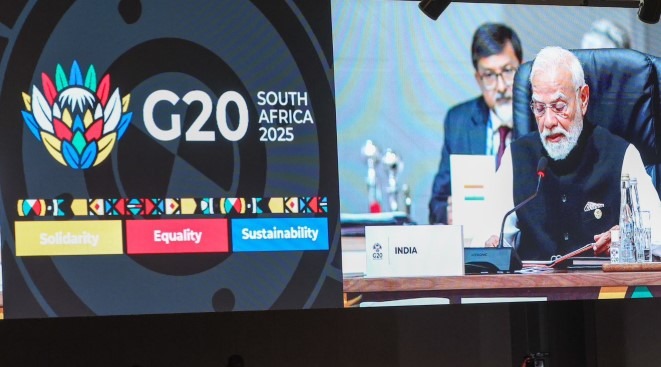
Prime Minister Narendra Modi proposed six new initiatives aimed at global development on the opening day of the G20 Leaders’ Summit in Johannesburg, South Africa, yesterday. These include the setting up of a Global Traditional Knowledge Repository, Africa Skills Multiplier program, Global Healthcare Response Team, initiative on Countering the drug-terror Nexus, Open Satellite Data Partnership, and a Critical Minerals Circularity initiative.
Addressing the two sessions on the opening day of the Summit, Mr Modi said, these initiatives elaborate India’s approach to growth, development and well-being for all. He said they will help achieve all-around growth. Speaking during the first session on inclusive and sustainable economic growth, the Prime Minister said, the G20 Global Traditional Knowledge Repository will harness the collective wisdom of humanity for the benefit of future generations.
The Africa Skills Multiplier program will aim to establish a pool of one million certified trainers for skilling the youth in Africa. He said, This will create local capacities and foster long-term development on the continent. Mr Modi also proposed setting up a G20 Global Healthcare Response Team, which will comprise healthcare experts from each of the G20 countries and could be deployed to deal with global health challenges in any part of the world. He also suggested a G20 Initiative on Countering the Drug-Terror Nexus to overcome the challenge of drug trafficking and break the drug-terror economy.
Speaking during the second session on ‘a Resilient World’, Prime Minister Modi proposed that the creation of the Critical Minerals Circularity Initiative will foster recycling, urban mining, second-life battery projects and related innovations. He said the initiative aims to help strengthen supply chain security and develop cleaner pathways of development. The Prime Minister asserted that India is fully committed to sustainability and clean energy. On Open Satellite Data Partnership, he said, through this program, satellite data of G-20 Space agencies would be made available to developing countries, especially the Global South, for agriculture, fisheries, disaster management, among other activities.
During the second session, Mr Modi also called for greater collective action on the climate agenda to strengthen global food security, highlighting the Deccan Principles on Food Security adopted during India’s G20 Presidency. He said the deliberations in this session focused on building a resilient world in the face of disasters, climate change, and ensuring just energy transitions, along with robust food systems. He said India has been actively working across these domains, building a future that is human-centric, inclusive, and rooted in global cooperation. He also welcomed the continuation of the Disaster Risk Reduction Working Group initiated under India’s presidency, and urged G20 members to collaborate with the Coalition for Disaster Resilient Infrastructure (CDRI) to mobilise finance, technology, and skills. Calling climate change a major threat to agriculture and global food security, Mr Modi outlined India’s efforts to address these challenges through the world’s largest food security and nutrition programme, the world’s largest health insurance scheme, and comprehensive crop insurance coverage.




















 WhatsApp us