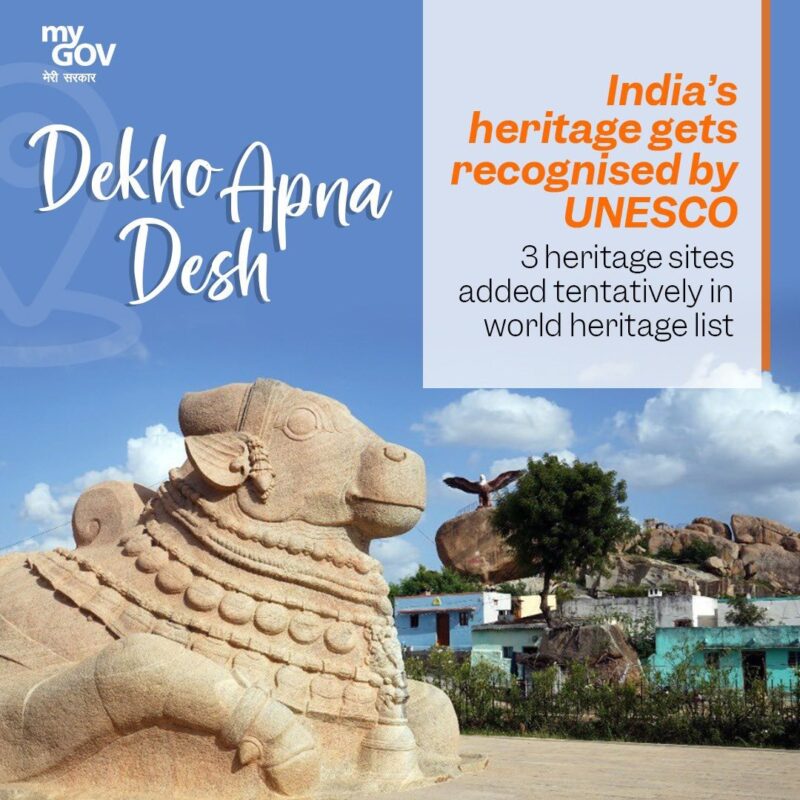
Three of India’s cultural heritages have made it to the tentative list of the UNESCO World Heritage Sites, taking the total on the tentative list to 49. A World Heritage Site is a landmark or area with legal protection by an international convention administered by the United Nations Educational, Scientific, and Cultural Organization (UNESCO).
Designated by UNESCO, the tag is given for having any cultural, historical, scientific, or other forms of significance. At present, there are 40 UNESCO World Heritage Sites in India including Agra Fort, Ajanta Caves, Ellora Caves, and Taj Mahal among several others.
Three new additions
Three new sites having cultural importance, namely Maharashtra’s Geoglyphs of Konkan Region, Meghalaya’s JingKieng Jri, and Andhra Pradesh’s Sri Veerbhadra Temple and Monolithic Bull (Nandi), made it to the new tentative list. According to a March 2021 press release by the Ministry of Culture, India had 42 sites listed under the Tentative List which is a pre-requisite condition for inscription as a World Heritage Site.
Geoglyphs of Konkan Region, Maharashtra: “The geoglyphs are unique and the most remarkable open-air ensemble of prehistoric human expressions of rock art,” said Union Cultural Minister G Kishan Reddy.
A geoglyph is a work of art that is created by arranging or moving objects within a landscape. These objects are usually stones or earth. To create this art form, artists arrange/ add/ remove objects to create the art in a structured pattern to create lines or spaces that contrast with the surrounding terrain.
The Geoglyphs of Konkan region are a critical typology of material heritage being the only evidence of human settlement in the Konkan region. Their features also point to their continued existence from the Mesolithic era till the early historic era. Furthermore, these are also evidence of the existence of certain types of faunal lifeforms that are no longer present in the region today.
JingKieng Jri, Living Root Bridge Cultural Landscapes, Meghalaya:
Jingkieng Jri are bridges, created by human beings. These aerial bridges are created by weaving and manipulating the roots of the Indian Rubber tree. Although the Living Root Bridge takes around 10 to 15 years to take shape, it can last up to 500 years.
The living root bridges not only stand out for their exemplary human-environment confluence but are symbolism of connectivity and resilience. The Jingkieng Jri bridges are ever-evolving and have the potential to hold 50 or more people in one go. Found mostly over streams running through the forests, these are grown by trained Khasi and Jaintia tribes.
Sri Veerbhadra Temple and Monolithic Bull (Nandi), Lepakshi, Andhra Pradesh: Also known as the Lepakshi temple, it is dedicated to Lord Veerabhadra – the incarnation of Lord Shiva. Situated in Lepakshi, in the Anantpur district of Andhra Pradesh, the Veerabhadra Temple is famous for its sculptures and archaeological magnificence shaped by the artists of Vijayanagara Empire. The temple is divided into three sections ‘MukhaMandapa’, ‘ArthaMandapa’ and ‘GarbhaGriha’, and the ‘KalyanaMandapa’. A ten-day long festival is also celebrated at the temple, attended by Shiva devotees.
The monolithic idol of Nandi Bull, the mount of Lord Shiva is crafted out of a single granite stone which is regarded as the finest specimen of Vijayanagara style of architecture.
Difference between a World Heritage site & Tentative List
A World Heritage Site is a place that is listed by UNESCO for its special cultural or physical significance. The list of World Heritage Sites is maintained by the international ‘World Heritage Programme’, administered by the UNESCO World Heritage Committee.



























 WhatsApp us