NEW DELHI August 13: Eyeing an election next year, India’s government announced massive spending for rural areas and projected economic growth above 8 percent in an annual budget on Thursday that won broad approval from economists, though bond and share markets fell.
Delivering the government’s last full annual budget before a general election to be held by May next year, Finance Minister Arun Jaitley also announced plans for “the world’s largest government funded health care program”, saying it would cover some 500 million of the country’s poorest people.
He went on to declare intentions to merge three public sector insurance companies and to list the new entity.
Spending in fiscal 2018/19 was projected to increase by 13.2 percent from the current year ending in March, with about three-fifths allocated to better infrastructure in the countryside, where two-thirds of India’s 1.3 billion people live.
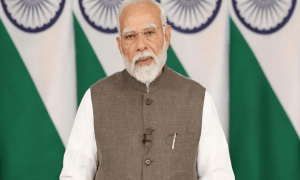
“This budget is farmer friendly, common citizen friendly, business environment friendly and development friendly. It will add to ease of living,” Prime Minister Narendra Modi told state-run Doordarshan Television.
Allocating 14.34 trillion Indian rupees ($225.5 billion) for rural infrastructure, Jaitley said the spending should create and new businesses, build new roads, housing, sanitation, and electrification in villages.
The finance minister later told Doordarshan that the largesse was nothing to do with winning votes for Modi’s nationalist Bharatiya Janata Party (BJP).
Analysts thought otherwise.
“It looks like that the BJP is aiming to shore up support among rural voters, there’ve been plenty of measures announced to boost the rural economy,” said Shilan Shah, India economist, at Capital Economics in Singapore. “It was no surprise to us that they relaxed the deficit targets.”.
The budget targeted a fiscal deficit of 3.3 percent of GDP in 2018/19, compared with expectations for a deficit of 3.2 percent.
The 2018/19 deficit target marks some slippage from a previous target of 3.0 percent for the year, and investors were also unnerved by the disclosure that this year’s deficit was likely to come in at 3.5 percent, much higher than expected.
Unlike the bond market, analysts were unalarmed.
Joy Rankothge, vice president at Moody’s Investors Service, said the budget remained broadly in line with the government’s fiscal consolidation path, and reinforced the credit rating agency’s rationale for awarding India last November its first rating upgrade in 14 years.
The deficit numbers were too high for bond investors’ taste as yields for India’s benchmark 10-year bond rose as much as 17 basis points.
A previously buoyant share market also retreated following the imposition of a new tax on long term gains from stocks, though healthcare shares rose thanks to the new health insurance program.
Jaitley cut corporate tax for small firms from 30 percent to 25, but ignored pleas from big companies that had sought a similar reduction to make them competitive with the rest of Asia.
To fund some of the spending, he set a target to raise 800 billion rupees next fiscal year from asset sales, after saying revenue from stake sales this year will reach a record 1 trillion rupees.
The government has already begun the process to sell stakes in two dozen state companies, including flag carrier Air India.
Rahul Gandhi, leader of the main opposition Congress party,
said the BJP government was continuing to make empty promises.
The government’s botched roll out of a nationwide goods and service tax (GST) in 2017, and a shock move to ban high value currency notes in late 2016 were partly to blame for economic growth falling to 6.7 percent in the current fiscal year – the slowest in three years.
“Four years gone, fancy schemes with no matching budgets, four years gone, no jobs for our youth,” Gandhi said in a Twitter post.
WEAKER MARKETS
Economists were, however, in broad agreement that the budget should help foster economic growth. A economic survey released by the government earlier this week trumpeted expectations that India would soon become the world’s fastest growing major economy.
Jaitley forecast the economy would grow 7.2 percent in 2018/19 and soon accelerate above 8 percent, the level needed to generate enough jobs for the hundreds of thousands of young people entering the labor market each year.
Already tentative signs of a recovery have emerged.
Prospects of improving corporate earnings have sent shares to a series of record highs. The broader NSE index .NSEI gained 4.7 percent in January – its best monthly performance since October.
Still, the government desperately needs banks to start lending again to kickstart private investment, and last year it announced an off-budget scheme to inject 2.11 trillion Indian rupees ($33 billion) into its state-run lenders.
The surge in world crude prices, and inflation running at a 17-month high of 5.21 percent and way above the central bank’s 4 percent target were other reasons for caution, but analysts tended toward the positive.
“All-in-all, it was a business-as-usual budget for India and a great one for Bharat (rural India),” Amar Ambani, partner and head of research at IIFL in Mumbai said. “The government did what it thought necessary to boost revenue, revive growth and get election-ready.”
($1 = 64.0450 Indian rupees)

















 WhatsApp us