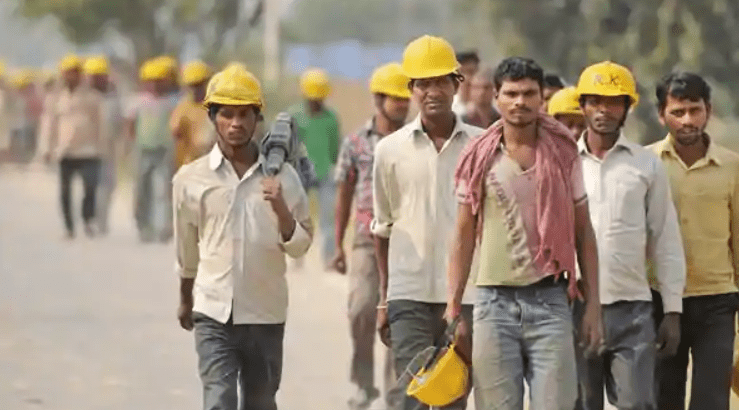
In a landmark policy shift, the Central Government on Monday notified the implementation of four long-awaited labour codes, setting the stage for the most sweeping overhaul of India’s labour legislation in decades. The reform package aims to simplify the country’s complex labour framework and ensure stronger protections for millions of workers.
Announcing the rollout on social media, Union Labour and Employment Minister Dr. Mansukh Mandaviya described the move as a decisive step toward ensuring better wages, safety, social security and dignity for the nation’s workforce. “These are not just policy updates,” he wrote. “They represent the Government’s Guarantee of Dignity for Every Worker.”
The labour reform package includes the following codes, all of which take effect today:
Code on Wages, 2019
Industrial Relations Code, 2020
Social Security Code, 2020
Occupational Safety, Health and Working Conditions Code, 2020
A Decade-Long Leap in Social Security Coverage
The Labour Ministry highlighted the country’s significant progress in expanding social-security benefits over the last ten years.
According to official data, social security coverage rose from 19% of the workforce in 2015 to more than 64% in 2025, marking a dramatic transformation in India’s labour landscape.
Officials said that the implementation of the four labour codes represents the next big step in this trajectory. The new framework is expected to bring millions more under social-security protection and enable portability of benefits across employers, states and sectors — a key challenge for migrant and informal workers.
What Changes for Workers? Key Benefits Explained
The government said workers across sectors especially informal and contract-based employees will benefit from several new rights and protections.
Timely Minimum Wages
For the first time, every worker in the country, regardless of industry or job nature, is entitled to regular minimum wage payments.
Appointment Letters for Young Workers
Employers must issue formal appointment letters, ensuring greater transparency, documented terms of service and reduced exploitation.
Equal Pay and Safer Workspaces for Women
The codes mandate gender parity in wages and aim to strengthen safety standards for women across sectors.
Social Security for 40 Crore Workers
A unified social security net will now cover gig workers, platform workers, migrant labour, and unorganised-sector employees.
Gratuity for Fixed-Term Contracts
Fixed-term employees will receive gratuity after one year of service — a benefit earlier limited to permanent staff.
Free Annual Health Check-Ups for Workers Over 40
A major emphasis has been placed on preventive healthcare, especially for workers in labour-intensive industries.
Double Wages for Overtime Work
Clear compensation rules will ensure workers are paid fairly for additional hours.
Enhanced Protection in Hazardous Sectors
Mandatory health safety norms will be strengthened for workers exposed to high-risk environments.
Alignment with Global Labour Standards
The government says the new system brings India closer to international labour benchmarks, ensuring wider social justice.
The announcement has been welcomed as a major structural reform, though labour unions and industry bodies are expected to analyse its long-term impact in the coming weeks. For now, the government maintains that the codes will usher in a modern, worker-centric labour ecosystem designed to support India’s rapidly evolving economy.
Four Labour Codes: Sector-Wise Benefits for India’s Workforce
With the implementation of the new labour codes, the Central Government has introduced sweeping reforms that directly impact workers across sectors. Beyond simplifying decades-old labour laws, the new framework promises stronger social security, better wages, safer workplaces and uniform protection for employees in every industry.
Here is a detailed look at how different sectors stand to benefit:
- Fixed-Term Employees (FTE): Major Gains for Contract-Based Workforce
Fixed-term employees will now receive all benefits at par with permanent workers, including leave, medical and social-security coverage.
Eligibility for gratuity reduced to one year instead of five.
Equal wages ensure better income stability and formal protection.
Reforms encourage direct hiring and reduce overuse of contractual employment.
- Gig & Platform Workers: First-Time Legal Recognition
Terms like gig work, platform work and aggregators have been formally defined.
Aggregator companies must contribute 1–2% of annual turnover (capped at 5% of payout) toward worker welfare funds.
Aadhaar-linked Universal Account Number (UAN) ensures fully portable benefits across states, enabling access even after migration.
- Contract Workers: Improved Security and Mandatory Health Benefits
FTE provisions boost employability and provide permanent-employee-like protections.
One year of continuous service makes contract workers eligible for gratuity.
Principal employer must provide health facilities and social-security benefits.
Free annual health check-up mandated for workers.
- Women Workers: Strong Legal Safeguards and Equal Opportunities
Gender discrimination explicitly prohibited.
Equal pay for equal work enforced.
Women allowed to work night shifts and even in high-risk jobs (mining, heavy machinery) with consent and safety arrangements.
Mandatory women’s representation in grievance committees.
Family definition expanded to include parents-in-law for benefit coverage.
- Youth Workers: Appointment Letters and Wage Protection
Minimum wage guaranteed across all sectors.
Appointment letters made compulsory to promote formal employment.
Workers must receive wages even during approved leave.
Floor wage determined by the Centre ensures a basic standard of living.
- MSME Workers: Uniform Protections Across Small Industries
All MSME employees covered under the Social Security Code.
Minimum wage mandatory for every worker.
Access to basic workplace facilities like canteens, clean drinking water and rest areas.
Standard working hours, paid leave and double overtime enforced.
Timely payment of wages made compulsory.
- Beedi & Cigar Workers: Structured Work Hours and Guaranteed Pay
Minimum wages ensured for all workers.
Working hours capped at 8–12 hours per day, 48 hours per week.
Overtime allowed only with consent and must be paid at double wages.
Timely wage payment mandated.
Workers eligible for bonus after 30 days of work.
- Plantation Workers: Broader Coverage and Full Medical Benefits
Plantation workers brought under OSHWC and Social Security Codes.
Codes apply to plantations with 10+ workers or 5+ hectares of area.
Mandatory safety training on handling agricultural chemicals.
Protective equipment made compulsory.
Full ESI medical facilities for workers and their families; children to receive educational support.
- Audio-Visual & Digital Media Workers: From Artists to Journalists
Journalists, digital content workers, dubbing artists and stunt professionals now get full labour protections.
Written appointment letters mandatory.
Timely payment of wages required.
Overtime beyond fixed hours must be consensual and paid at double rate.
- Mine Workers: Stronger Safety and Health Framework
Certain commuting accidents recognised as employment-linked under conditions.
Centre to notify uniform national safety standards.
Mandatory free annual health check-ups.
Working hours set between 8–12 hours per day, 48 hours per week.
- Hazardous Industry Workers: High-Risk Sectors Get Higher Protection
Free annual health check-ups for all workers.
National safety standards to be framed by the Centre.
Women allowed to work in hazardous and underground jobs with consent.
Safety committees mandatory at every hazardous worksite.
- Textile Workers: Equal Pay, Portability and Overtime Benefits
Migrant workers—direct or contract—eligible for equal wages and welfare benefits.
Workers can claim pending dues for up to three years.
Double pay for overtime hours ensured.
PDS portability for migrant families.
- IT & ITES Workers: Transparency and Timely Salaries
Salary must be released by the 7th of every month.
Mandatory equal pay for equal work.
Women permitted to work night shifts with safety protocols.
Time-bound resolution of harassment or wage disputes.
Social-security benefits assured through fixed-term employment norms.
- Dock Workers: Formal Recognition and Mandatory Health Cover
Dock workers receive formal legal status and protection.
Appointment letters made compulsory.
PF, pension and insurance benefits applicable even for temporary workers.
Annual employer-funded health check-up mandatory.
Facilities such as first aid, sanitation areas and clean drinking water required.
- Export Sector Workers: Special Provisions for Global-Linked Industries
Fixed-term workers to receive gratuity, PF and other social security benefits.
Annual leave available after 180 days of work.
No unauthorised wage deductions; timely payment ensured.
Women allowed night-shift duty with consent and robust safety measures.
Mandatory CCTV, transport and security arrangements for night operations.





















 WhatsApp us